Remote Patient Monitoring in 2026 Has a Model Problem
Table of Contents
At 2 a.m. on a Tuesday, the cardiology team at a mid-sized Ohio hospital watched a familiar story unfold on their EHR dashboard. A 68-year-old heart failure patient, Mr. Lewis, had been discharged just nine days earlier with all stable signs on record. Now he was back in the emergency department with fluid overload.
On the surface, it looks like a care miss. In reality, the team was receiving dozens of alerts from hundreds of patients every single day, each one stripped of context, priority, and any connection to social or behavioral risk. By the time anyone noticed Mr. Lewis’s numbers had been drifting, it was too late for a phone call to fix it.
The program performed exactly as designed. It still failed him.
That is the core problem with remote patient monitoring in 2026. It is running on a model built for a different era, and it has not kept up with what patients and care teams actually need.
Why the First-Generation RPM Model Is Failing
Most RPM programs were built around billing codes and device shipment, not continuous proactive care. That mismatch is now costing health systems real outcomes and real efficiency.
The standard RPM playbook has not changed much since 2018:
- Episodic enrollment after a hospitalization or new diagnosis
- A fixed kit of devices shipped to the home
- Rule-based threshold alerts routed to an overworked nurse queue
- Monthly compliance reports pulled for billing
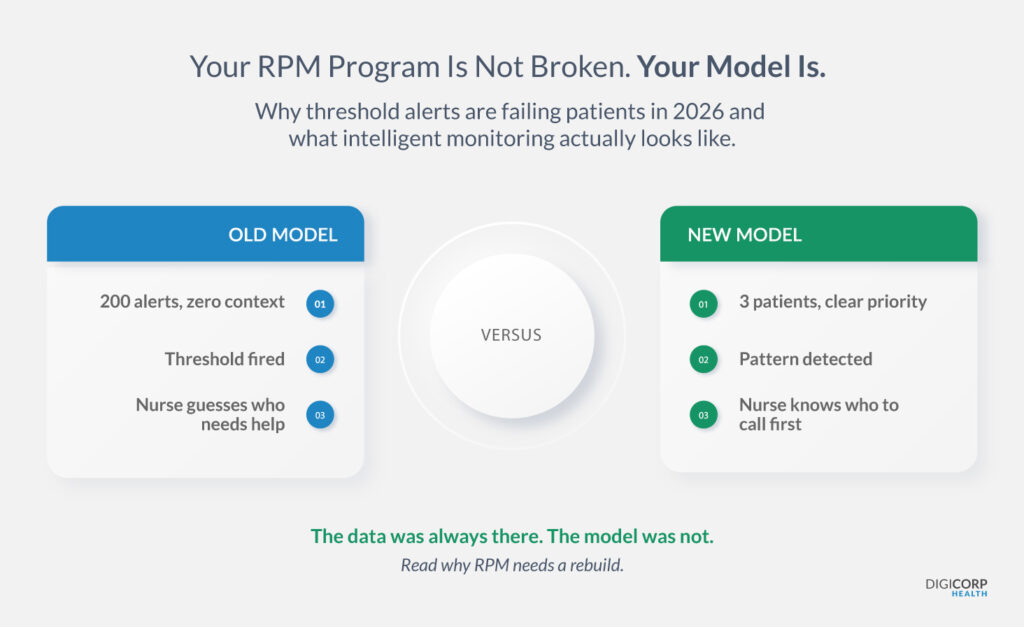
The result is alarm fatigue at scale. Nurses and care managers become monitoring analysts, manually reviewing queues, calling patients, and documenting across systems that were never designed to talk to each other. Staff burn out. RPM becomes a parallel program that sits beside patient care rather than being part of it.
Meanwhile, patient expectations have moved vastly. By 2026, people use apps that learn their patterns and respond in real time. A monitoring system that can only flag a blood pressure reading feels like a pager in a smartphone world.
What Remote Patient Monitoring in 2026 Actually Needs to Do
For RPM to remain relevant in 2026, it must shift from device management to continuous, risk-aware care. That means combining richer data, prioritizing patients dynamically, and integrating directly into clinical workflows.
A modern RPM model must do three things well.
1. Combine data streams, not just vitals
Weight readings mean nothing in isolation. They mean something when combined with medication fill history, recent ED utilization, self-reported symptoms, and behavioral signals like app engagement. The richer the context, the earlier the warning.
2. Prioritize by risk, not by threshold
Every threshold breach landing in the same queue is not prioritization. It is noise. Care teams need ranked worklists showing which patients are most likely to deteriorate this week, with clear explanations, not an ad hoc 200 undifferentiated alerts.
3. Integrate into existing clinical workflows
RPM as a standalone program fails because clinicians do not have bandwidth for another system. Insights need to surface inside the EHR and care management tools the team already uses every day.
Organizations that have embedded RPM this way report better outcomes and more sustainable workflows. The difference is not subtle.
How AI Changes the RPM Equation
AI does not replace clinical judgment in RPM. It handles pattern detection at scale so clinicians can stay focused on decisions, not triage.
When a health system monitors thousands of chronic disease patients at once, no team can manually review every alert and trend. The math simply does not work. AI becomes the layer that makes it manageable.
In practical terms, AI in remote patient monitoring can do three things:
- Predict risk before crisis hits – Longitudinal models analyzing vitals, symptoms, and utilization can identify patients likely to be hospitalized in the next 7 to 14 days, before they feel acutely unwell.
- Filter alerts by clinical relevance – Instead of a raw queue, care teams see a ranked, explainable list. Not a random “weight gain alert,” but a complete picture: rising weight, missed diuretic refills, and reduced app engagement that together signal a climbing risk score.
- Personalize outreach based on behavior – Which patients respond to proactive coaching calls? Which ones need a care navigator rather than a nurse? Past interaction data can shape the next intervention rather than leaving it to guesswork.
The value is not in the AI itself, it is in what the AI lets the care team do: focus on the patients who need them most, with enough context to actually help.
One important caveat: AI in RPM must meet clear standards for transparency, bias mitigation, and data security. When algorithmic outputs influence care plans, clinicians need to understand why a patient was flagged, not just that they were.
The Real Blockers Are Not Technical
Fragmented systems, workforce burden, reimbursement complexity, and patient equity gaps are the real barriers. More devices and dashboards will not solve any of them.
Anyone who has worked inside a health system already knows what the actual obstacles are.

Fragmented Tech Stacks
RPM platforms, telehealth tools, and EHR systems that do not share data cleanly produce duplicated work and inconsistent patient views.
Care teams end up context-switching instead of caring for patients.

Workforce Burden
Nurses managing monitoring programs are analysts first, clinicians second.
That is a design failure, not a staffing problem.

Reimbursement Friction
RPM reimbursement pathways exist in the U.S., but aligning program design with financial sustainability and value-based care contracts is still a real operational challenge.

Patient Equity
RPM programs that assume device access, stable connectivity, and digital literacy will widen disparities rather than close them, as recent analyses of RPM programs have noted.
Successful programs are designed intentionally for language needs, low-resource settings, and patients who need a human touchpoint.
A platform-level rethink of how monitoring is designed and governed is what is actually needed here. Not more tools layered on top of a broken model.
What Mr. Lewis’s Story Looks Like With a Better Program
Reimagine Mr. Lewis under an RPM program built on unified data and AI-driven prioritization.
His weight trend, medication fills, recent ED visit, and app engagement all feed into a single risk model from the day he is discharged. Three days before he feels acutely unwell, his score starts to climb. Not because a threshold fired, but because a pattern emerged that a rules engine would have missed entirely.
A nurse sees his name near the top of a ranked worklist. The explanation is right there: rising weight, missed diuretic refills, reduced engagement over the past 48 hours. She calls him. The cardiologist reviews the situation and adjusts the care plan through a telehealth visit. The readmission does not happen.
At scale, those avoided crises mean better outcomes, lower costs, and a more humane experience of living with a chronic condition.
That is not a technology tale. Health systems are running versions of this today. The question is whether the rest of the industry stops treating RPM as a monitoring program and starts treating it as what it needs to be: an intelligent, integrated, continuously improving extension of care.
Devices do not prevent readmissions. Intelligent, integrated care does. DigiCorp helps health systems build RPM programs that prioritize the right patients at the right time, with the clinical context to act fast.
Schedule A Call Now
Sanket Patel
- Posted on May 25, 2026
Table of Contents