FDA AI Signals in 2026: What Will Break If You Ignore It
Table of Contents
In 2025, we explained how the FDA’s draft guidance on AI-enabled medical devices introduced a Total Product Life Cycle, or TPLC, mindset to healthcare AI. The message was simple: plan for validation, risk management, transparency, change control, and real-world performance.
In 2026, the real test is whether healthtech companies can turn those principles into the way they actually build and operate their products.
Because when they can’t, the first thing to break isn’t compliance. It is the company’s ability to update a product safely, defend its clinical claims, maintain provider trust, and scale without regulatory friction that could have been avoided.
The FDA Signal Has Expanded
In August 2026, the FDA’s Digital Health Center of Excellence published a discussion paper on the regulation of generative AI-enabled medical devices. It looks at risk assessment, premarket evaluation, postmarket monitoring, and other regulatory questions specific to GenAI-enabled devices.
There is an important distinction here. This is not draft or final FDA guidance. It does not establish new requirements or communicate the FDA’s final expectations for future marketing submissions. Instead, the paper is intended to gather feedback from manufacturers, clinicians, researchers, and other stakeholders.
Still, it matters.
The paper gives healthtech companies a useful view into the questions the FDA is thinking about as these products become more capable and more deeply embedded in clinical workflows. Waiting for final requirements before addressing those questions could leave companies trying to rebuild processes and products after the fact.
As AI systems become more capable, rely on more external models and data sources, and take on more consequential roles in healthcare, “Does the model work?” is no longer the only question.
Companies also need to ask:
- What is the product allowed to do?
- How much influence does it have on clinical decisions?
- What changes after deployment, and who approves them?
- What happens when a third-party component changes?
- Can the company monitor, explain, and control the product over time?
Five things that break without AI governance
1. Your AI Product Release Process
Fast iteration sounds great until you’re working in a regulated environment.
A change to an AI-enabled device can affect safety, effectiveness, intended use, performance, labeling, or clinical workflow. Without a clear process for assessing, validating, approving, and monitoring those changes, every release can turn into a cross-functional bottleneck.
The FDA’s final guidance on Predetermined Change Control Plans, or PCCPs, provides a way to plan for certain future changes. A PCCP describes the changes a manufacturer expects to make, how those changes will be developed and validated, and how their impact will be assessed. When included in an authorized marketing submission, it can allow certain planned changes to be implemented without a new submission for each individual change. It is not blanket approval for future updates. Changes still need to stay within the boundaries reviewed by the FDA.
The practical takeaway here is to define your change boundaries before your product roadmap depends on them.
2. Your Clinical Validation and Evidence
A model can perform well during development and still behave differently in a real clinical environment.
The FDA’s PCCP guidance emphasizes that data used for training and testing should reflect the intended use population, with test data independent of and generally drawn from different sites than the training data.
That matters because performance can change with patient populations, disease prevalence, care settings, imaging equipment, EHR configurations, and user behavior.
A diagnostic support model trained and tested across a small number of sites may perform differently when it reaches a new provider network.
So the question isn’t simply whether the model is accurate. It is whether you have enough evidence to trust its performance in the setting where it will actually be used.
3. Your Medical Device Intended Use
This is where generative AI makes things particularly difficult.
A product may start as a note summarization tool, but its interface, prompts, workflow, or marketing claims can gradually push it into areas such as triage, diagnosis, or treatment recommendations.
That is where product design and regulatory strategy need to stay closely connected.
Ask directly:
- Who is expected to use this system?
- Is the output informational, assistive, or clinically consequential?
- Can a clinician review, override, or reject it?
- Do the product claims, user instructions, and validation evidence all describe the same intended use?
Not every AI feature meets FDA’s definition of a device function. But you should know where that line sits well before commercialization.
4. Your Third-Party AI and Vendor Controls
Foundation models, external APIs, and third-party AI tools can help companies move faster. They also introduce dependencies that the product team does not fully control.
A model version can change. An API can be updated. A retrieval source can change. A vendor can alter its release configuration.
If those components influence your product, they cannot remain a black box.
Providers and other healthcare customers will want to know:
- What data does the product use, and how is it handled?
- What happens when an underlying model changes?
- Can you investigate an unexpected output?
- Is there a clear record of updates and user interactions?
These aren’t just technical questions. They can affect whether a product is trusted and deployable in a clinical environment.
5. Your Quality Management and Audit Trail
The FDA’s Quality Management System Regulation, or QMSR, became effective on February 2, 2026. It amended the device’s current good manufacturing practice requirements under 21 CFR Part 820 and incorporated ISO 13485:2016 by reference. The FDA also began using its updated medical device inspection process on the same date.
For companies building AI-enabled medical devices, that makes traceability even more important.
You should be able to connect:
- Product requirements to intended use
- Data decisions to risk assessments
- Model changes to verification and validation
- Release decisions to documentation and sign-off
- Performance signals to investigation and corrective action
- User-facing claims to supporting evidence
This doesn’t mean every early-stage company needs a large documentation team.
It means the quality system needs to match the product’s risk and maturity, before important decisions and evidence become difficult to reconstruct.
Compliance-ready means architecture-ready
The clearest lesson from FDA’s evolving AI work: compliance isn’t a document package you assemble before a submission. It has to be built into the product itself.
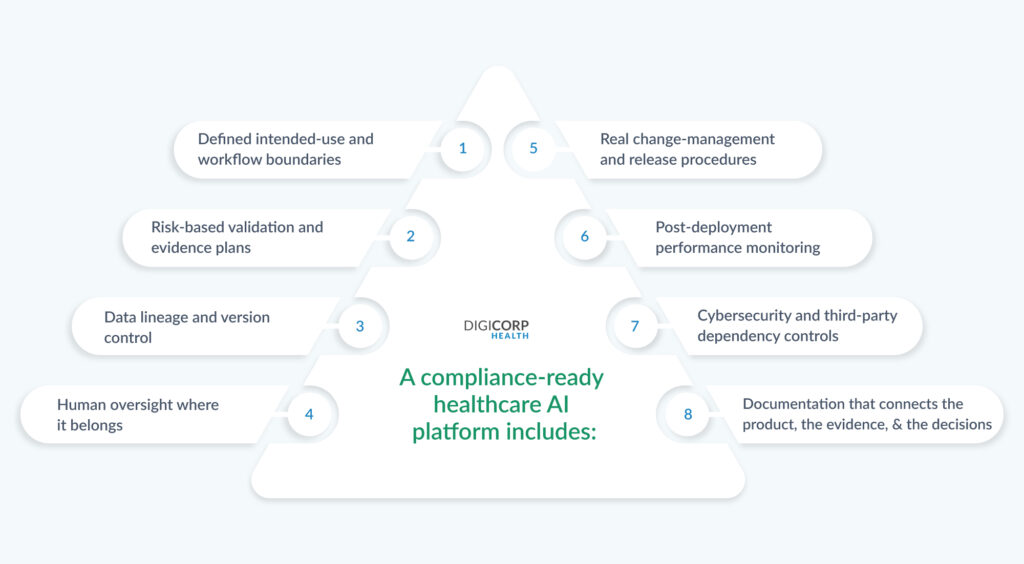
The goal isn’t to slow innovation down with process. It is to build products that can evolve responsibly, stand up to clinical and enterprise scrutiny, and scale without avoidable surprises.
How Digicorp Health helps
At DigiCorp Health, we help healthcare companies turn regulatory requirements into practical product and technology decisions. From architecture and documentation to change management and compliance controls, we help teams build products that are ready to scale and adapt as requirements evolve.
Schedule A Call Now
Sanket Patel
- Posted on September 7, 2026
Table of Contents