The Dark Side of Healthcare Interoperability: Shadow Data and Shadow AI Risks
Table of Contents
For years, healthcare has pursued one ambitious goal: seamless interoperability. Organizations have invested heavily in modernizing infrastructure, adopting standards like FHIR, and connecting systems that once operated in isolation. The objective was straightforward: enable patient information to move securely and efficiently across providers, payers, and digital health applications.
By many measures, that effort has been successful. EHR platforms now exchange data with payer systems through FHIR APIs. Remote patient monitoring devices stream health data in near real time. Care management platforms pull information from multiple clinical systems, while AI-powered tools summarize visits, automate documentation, and support clinical decision-making. Healthcare has never been more connected than this.
But connectivity has introduced a new challenge that many organizations are only beginning to recognise. Every integration, analytics platform, and AI application creates new copies of patient data, often outside the visibility of enterprise governance. What began as an interoperability initiative is quietly becoming an AI governance challenge, where organizations can no longer assume that every system, dashboard, or model is working from the same trusted source of truth.
While healthcare leaders celebrate the velocity and volume of data movement, their organizations are quietly creating a parallel, unmonitored digital universe. Every new API integration, population health dashboard, and department-specific tool generates yet another copy of clinical data. These replicas are usually introduced to improve performance, simplify reporting, or support local operations. Yet they are rarely inventoried, monitored, or governed with the same rigor as the primary clinical record.
Healthcare Has Solved Data Movement, Not Data Governance
FHIR has transformed how healthcare systems exchange information. What it hasn’t solved is what happens to that data after it reaches its destination.
Today, a single patient record doesn’t simply move between systems. It gets copied, cached, and stored across multiple platforms:
Most of these systems keep their own copy of the data to improve performance or support reporting. Over time, those copies drift away from the original record, creating multiple versions of the same patient information.
While health system leadership in the boardroom believes their clinical teams and algorithms are all referencing the same, unified patient record, the operational reality is terrifyingly fragmented. The industry has made massive progress in data movement, but it has completely lost custody of data governance.
What Shadow Data Actually Looks Like
Unlike traditional shadow IT, shadow data is not the result of rogue employees downloading unauthorized software or trying to bypass corporate protocols. Instead, shadow data grows naturally, as a byproduct of digital transformation.
As hospitals adopt more applications, data is routinely copied to improve performance, support reporting, or enable new workflows. Common examples include:
Five everyday sources of shadow data
- Research or testing environments that retain data long after a project ends
- Local FHIR repositories created by analytics platforms for faster queries
- Vendor-managed databases that store patient data to power specialty applications
- Departmental spreadsheets exported when standard reports don’t answer operational questions
- AI application caches that temporarily store patient information to speed up responses
None of these instances appear dangerous or malicious in isolation. In fact, they are usually created to solve genuine operational inefficiencies. Collectively, however, they build a disorganized patchwork of competing versions of patient reality.
Why Shadow Data Creates Shadow AI
This is where the dark side of interoperability collides with that of AI. Modern healthcare AI depends on the data it receives, with no way to know whether the information it accesses is the latest clinical record or an outdated copy. One model may access the latest medication history, while another relies on a cached copy that hasn’t been updated. Both generate recommendations, but neither is working with the same clinical picture.
Shadow AI rarely begins with unauthorized models; it begins with unauthorized data. When organizations deploy predictive algorithms across an enterprise littered with shadow data, they unknowingly introduce structural risks that directly threaten clinical safety and organizational liability.
Divergent answers to the same clinical question
One AI reads the live EHR. Another reads a cache from yesterday. Same patient, two different recommendations, and no code is actually broken.
Explainability becomes harder
If a sepsis flag or a denial can’t be traced to its source data, audits, regulatory reviews, and internal investigations all stall.
Shadow data quietly increases bias
Stale or incomplete copies feed biased predictions gradually, often invisible until outcomes or model performance already show it.
Why FHIR Alone Cannot Solve This Crisis
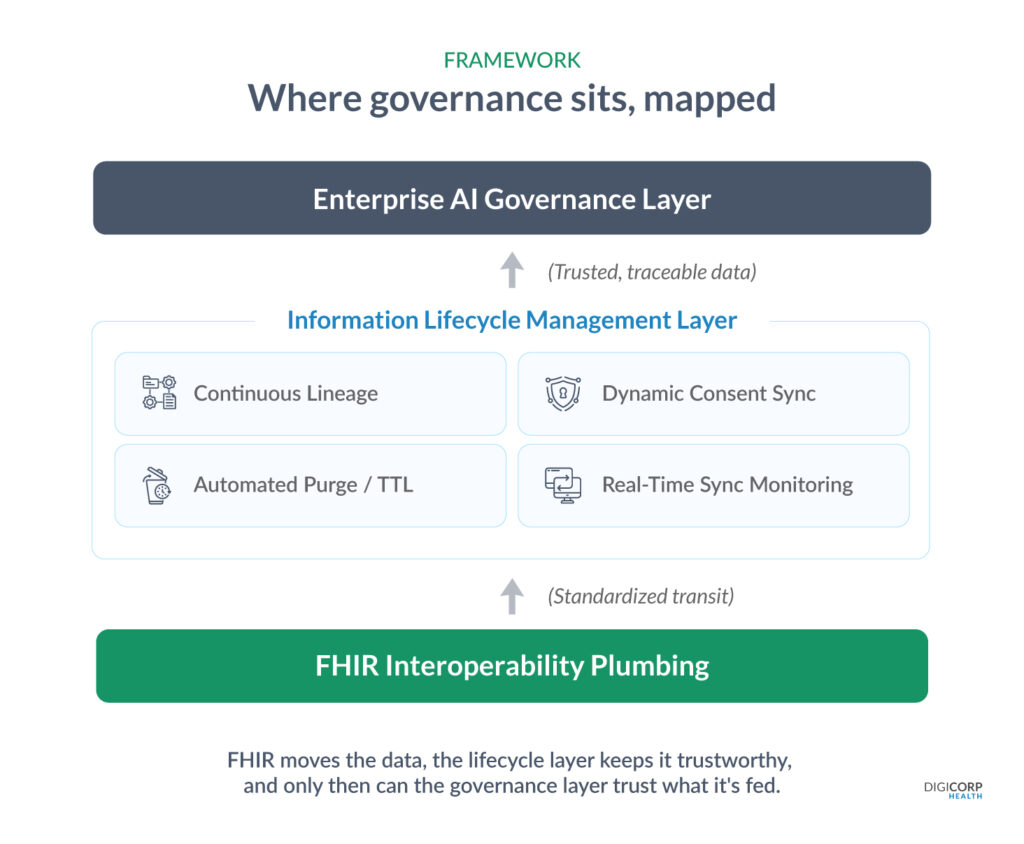
Many healthcare organizations assume that investing in more FHIR infrastructure will automatically solve these data challenges. In reality, FHIR is a language framework, not a governance strategy. It standardizes how data is exchanged, but it does not govern where data lives, how long copies persist, or how duplicated records are managed.
As organizations deploy more APIs, they also increase the number of places where patient data is copied and stored. Without explicit governance controls layered on top of the interoperability stack, more connectivity simply creates more shadow data at a scale that traditional IT governance struggles to manage.
To bridge this gap, healthcare CIOs must fundamentally shift the diagnostic questions they ask their technical teams. Instead of measuring success by the number of integrations, they should start measuring trust, visibility, and data governance.
| Outdated, volume-centric Thinking | Modern, trust-centric governance thinking |
| How many live FHIR APIs do we currently support? | How many distinct copies of patient data exist outside our primary EHR? |
| Are our downstream vendors compliant with HL7 standards? | Which clinical AI tools rely on cached or replicated data rather than live streams? |
| Can we successfully push data to our partner networks? | Can every single dataset in our ecosystem be traced back to its point of origin? |
| Have we implemented standard patient consent workflows? | How quickly and reliably do consent changes propagate to downstream shadow stores? |
The Solution: Building a Unified Data-Layer Governance Architecture
To mitigate the risks of shadow data and build a foundation for safe, scalable healthcare AI, organizations must pivot from basic integration to active information lifecycle management. Healthcare leaders must establish a modernized, data-layer governance architecture built around five core pillars.
Final Thoughts
One single question defined the last decade of digital health transformation: Can we connect these systems? Next decade will be defined by a more demanding question: Can we trust what these connections have created?
As healthcare accelerates AI adoption across clinical medicine, back-office revenue cycles, and population health initiatives, the greatest risk may not come from the models themselves. It comes from the unmanaged, unmonitored copies of data that these models silently depend upon to make life-and-death decisions.
DigiCorp helps health systems inventory shadow data, build lineage into every integration, and connect FHIR infrastructure to real governance, so every model in your stack is working from the same trusted record.
Schedule A Call Now
Sanket Patel
- Posted on July 29, 2026
Table of Contents